


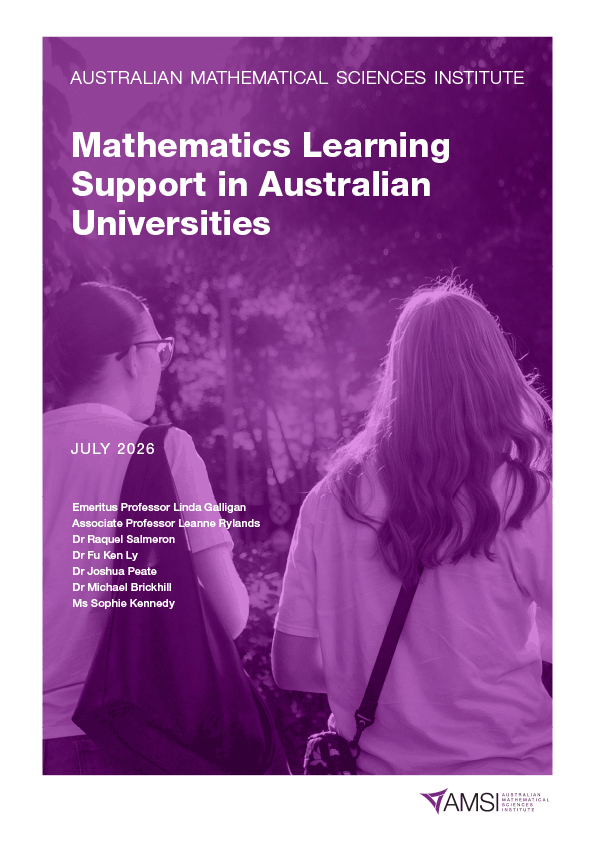
A report published by the Australian Mathematical Sciences Institute (AMSI) investigating the state of university support systems for mathematics students in Australia has revealed that while most universities provide mathematics support for students, it is fragmented, understaffed, underfunded, and difficult to find.
The 2026 Mathematics Learning Support in Australian Universities report was conducted from a desktop review and staff interviews at 40 Australian universities. It was researched by Emeritus Professor Linda Galligan (UniSQ), Associate Professor Leanne Rylands (Western Sydney University), Dr Raquel Salmeron (UniSQ), Dr Fu Ken Ly (University of Sydney), Dr Joshua Peate (Macquarie University), Dr Michael Brickhill (Southern Cross University), and Sophie Kennedy (AMSI).
State of play
The decline of mathematics participation across Australia is well documented. AMSI’s Year 12 Mathematics Participation Report Card 2025 revealed a deepening crisis in secondary school mathematics participation across the country, with the proportion of students studying higher and intermediate mathematics dropping to 8.4% and 16.8% respectively in 2023.
Australia has a growing mathematics skill gap. Participation in, and levels of, mathematics studied in senior secondary school has been in decline for over three decades, leaving many students underprepared for the demands of university study. Therefore, it is important that prospective mathematics undergraduates are confident that university-level support is both comprehensive and easily accessible.
Findings
The report’s findings suggest that Australian universities need to improve the numeracy support they provide in order for to students develop the skills required to succeed in their studies.
36 of the 40 universities surveyed provide some form of mathematics support. There is no uniform model. Rather than following a standardised national model, support is context‑driven and informed by institutional priorities, student demographics, and resourcing.
Some learning centres, particularly within mathematics departments, are staffed by academics within the discipline. Others, meanwhile, are staffed by those from an enabling program, by PhD students, by casual staff or by professional staff. Some universities do not have a dedicated learning centre, but provide support within other programs or sections of the institution.
Reasons provided for an absence of adequate support services included time constraints, staff changes and reductions in resources.
Artificial Intelligence
Artificial Intelligence (AI) was regularly mentioned as an emerging issue in mathematics teaching, diagnosis, and assessment. Drawn by its availability and ease of access, students are turning to AI as a shortcut for developing numeracy skills. This growing dependency could be fuelled by a fragmented approach to in-person mathematics learning support at university level.
It is anticipated that the influence of AI will grow exponentially as students become more aware of AI’s growing capabilities. However, this reliance deprives students of meaningful learning experiences, leaving them without the essential numeracy skills they should have upon graduation.
Green shoots
In some instances, there are signs of positive change. There is now more online assistance for both remote and on-campus students, with increased availability of well‑designed asynchronous options. Support is often better targeted today, especially through user‑friendly self‑testing tools linked to materials available in both print and video formats.
While there is concern about the future, especially around the use of AI, people working in the sector are connecting with organisations such as AALL Mathematics Advisors SIG, the LANTITE CoP, and the NAEEA STEM and Mathematics SIG for advice and assistance.
Recommendations
The report identified four recommendations for universities and government bodies to act upon. These recommendations will help to ensure university-level mathematics students have fair and equal access to mathematics supports:
1. Universities need to establish a designated role at each university where one academic has a thorough knowledge of all aspects of mathematics and statistics support and preparation in their university.
2. Form a national group consisting of university staff who actively support current students and prepare future students with mathematics and statistics.
3. Ensure resources are shared within each university and between them via a dedicated website.
4. Develop a numeracy framework to support the systematic embedding of academic numeracy across tertiary institutions.
Speaking on the publication of the report, AMSI Director Professor Tim Marchant said: “Mathematical literacy is critical to Australia’s future, yet too many students arrive at university underprepared and unsure of where to turn for help. This report shows that, while most universities offer mathematics learning support, it is often fragmented, hard to find, and subject to under‑resourcing.
“We cannot afford to leave students to navigate this alone or to rely on AI tools as a substitute for genuine understanding. We are calling for coordinated, well‑resourced and research‑informed support structures across Australian universities so that students who need help with numeracy can access it easily and build the skills they need to succeed in their degree and beyond.”
Co-author of the report, Emeritus Professor Linda Galligan (UniSQ), added: “We have all read about the decline in students completing mathematics at secondary school. Yet Australia needs STEM and data-driven professionals, as well as teachers, health experts, and business analysts.”
She continued: “The onus is on universities to ensure that students do not stumble at the first hurdle. When our researchers audited universities, they were hard-pressed to find clear answers to some simple questions. Universities should do better so that new students have the numeracy skills needed for their degree.”
About AMSI
AMSI is a not-for-profit peak body for the mathematical sciences with a breadth of members including Australian universities, professional societies, government agencies and industry. We champion mathematics, statistics and data science for Australia’s advancement through advocacy, facilitation, and collaboration.
Media Enquiries:
Robbie Byrne
Marketing, Communications and Events Coordinator, AMSI
robbie.byrne@amsi.org.au