


As we at the AMSI prepare to launch ICE-EM, our groundbreaking primary and secondary-level mathematics textbook series for Years 5-10, we reflect on why it was essential for us as the peak body for the mathematical sciences in Australia to develop a school educational resource that meaningfully integrates First Nations mathematical cultures and thinking.
Participation in school mathematics in Australia is at an all‑time low. At the same time, under‑represented groups in STEM, including First Nations students, girls and students in rural and remote areas, continue to face unequal educational outcomes. AMSI’s ambitious new textbook series seeks to address these concerning trends.
 Funded in part by the BHP Foundation, published in collaboration with Cambridge University Press and compiled by a team of expert mathematics educators, including the Maths Without Borders group at the Australian National University (ANU), ICE-EM goes further than any previous schools mathematics textbook series in its incorporation of First Nations mathematical thinking and cultures.
For AMSI, the timing was fortuitous. Just as the initial framework for the fourth edition of the ICE-EM series was being developed, guidelines for the Australian Mathematics Curriculum V9.0 were published by the Australian Curriculum, Assessment and Reporting Authority (ACARA). ACARA introduced the cross-curriculum priority of Aboriginal and Torres Strait Islander Histories and Cultures to provide First Nations students with the ability to see themselves, their identities and cultures reflected in the national curriculum.
Moment of insight
The updated Curriculum now placed an important lens on First Nations Peoples’ cultural content being taught within school subjects, including mathematics.
“It was a moment of insight,” says Professor Tim Marchant, Director of AMSI. “ACARA’s priority aligned with AMSI’s vision that all Australians have the opportunity to develop their maths skills and knowledge, and its strategy to grow participation of students experiencing disadvantage. The lightbulb went off that the AMSI ICE-EM textbook could be a leader in this context.”

AMSI Director, Tim Marchant, who was instrumental in the series’ writing process.
“AMSI had a mission to champion Australian mathematics — all 60,000 years of it!”, notes a mathematician of First Nations heritage at ANU, who helped to write the series’ First Nations content. For ANU, the opportunity to contribute its expertise to the project was appealing: “Teachers are keen to engage their diverse students, especially those of First Nations and minority-culture identities. Usually, though, they lack resources.
“It was a responsibility, be it a very pleasant one, for ANU to develop a resource that had the potential to foster respect for First Nations mathematical sciences and, ultimately, help channel more First Nations students into high-paying STEM sector careers.”
“The lightbulb went off that the AMSI ICE-EM textbook could be a leader in this context.”
AMSI Director, Tim Marchant
Pride
Aboriginal and Torres Strait Islander Peoples have strong and storied mathematical traditions and knowledge. ICE-EM seeks to not only base its curriculum-aligned First Nations mathematical content on their cultural knowledge and practices, but also on their mathematical thinking and understanding.
An ANU spokesperson explains that mathematics is a discipline which has been understood and practised by First Nations cultures for millennia: “Mathematics is not just about numbers — it can be about patterns, symmetries and relationships learned from lived experiences.” This idea forms the basis of much of the First Nations content in the series, from exploring kinship systems to understanding lunar cycles.
Features
Innovations across the ICE-EM series go beyond its groundbreaking First Nations content. A team of leading mathematicians developed the series’ core mathematics problems, including Prof. Tim Marchant, Dr Michael Evans formerly of Scotch College, Melbourne and Prof. Jacqui Ramagge of James Cook University. The experience that these authors bring is evident in how the series introduces new mathematical concepts, with each problem featuring clear instructions and logical topic sequence that builds confidence and strong foundational mathematics skills.
Other stand-out features include:
• Link-up with AMSI Calculate and AMSI Careers online resources.
• Hands-on activities for Years 5-10 that promote real-world mathematical thinking.
• New algorithmic thinking activities to build structured problem-solving skills.
• New curriculum topics include prism volume (Year 7), time zones (Year 8), data sampling methods (Year 9), and logarithmic scales, networks and combinatorics (Year 10).
• Incorporation of questions from the Australian Maths Trust’s competitions.
• Fully integrated digital support thanks to an Interactive Textbook.
• Complete alignment with the Australian Mathematics Curriculum V9.0 and the Victorian Mathematics Curriculum V2.0.
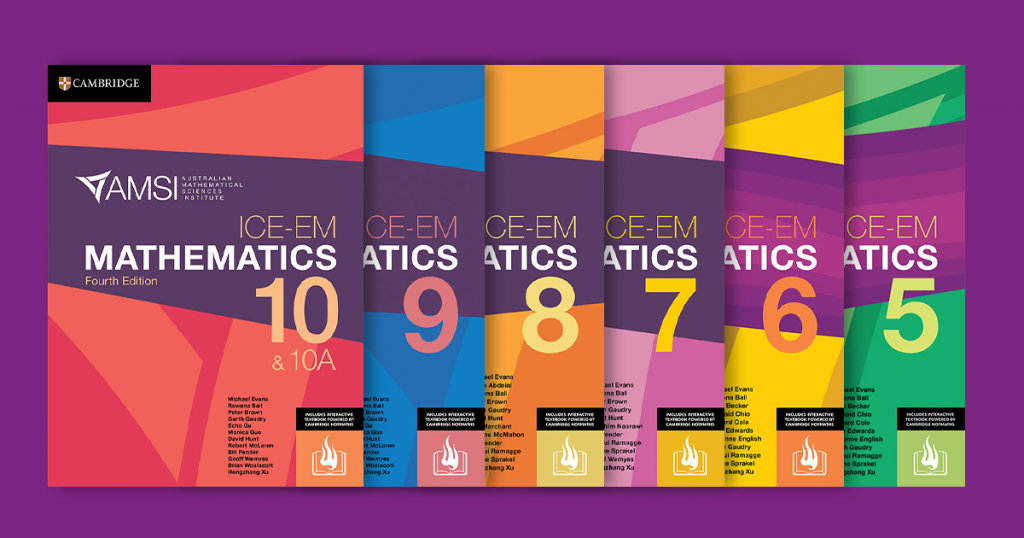
ICE-EM‘s groundbreaking approach to First Nations mathematical curriculum content, coupled with a suite of innovative digital aids for students and teachers has the potential to inspire a diverse new generation of mathematicians, and contribute to increased diversity and capacity in Australia’s STEM ecosystem.
The exchange of Aboriginal and Torres Strait Islander mathematical knowledges and cultures with non‑First Nations peers has the power to help build greater understanding and respect.
Meanwhile, the series’ carefully developed references to First Nations cultures serve to instil pride among First Nations Peoples that maths is not just an integral part of their cultures, but a discipline with real-world benefits that should be embraced. In the words of Prof Tim Marchant: “By studying these textbooks, students can grow up saying: ‘mathematics is my culture and community’. Take it forward with pride!”
ICE-EM is available for pre-order now through Cambridge University Press ahead of its publication in August 2026.
Media Enquiries:
Robbie Byrne
Marketing, Communications and Events Coordinator, AMSI
robbie.byrne@amsi.org.au